The ALLEN Patrilineage 1 Project
The ALLEN Patrilineage 1 Project
This ALLEN patrilineage project is dedicated to furthering the genealogical research of the members, each of whom has sponsored a Family Tree ySTR DNA test of 37 markers (or better) that matches to the haplotype pattern for this ALLEN patrilineage. Our goal is to promote both individual and collaborative genealogical research aimed at reconstructing the overall tree of descent from the patriarch common to all of the members, using their ySTR DNA test results to guide us in our research, and our conclusions.
NPEs (Non-Paternity Events) and non-ALLEN Surnames
Of the current members of this project, several grew up with surnames other than ALLEN, indicating that an NPE has occurred somewhere in their ancestral lineage. This is typical of most patrilineages. There is a small chance every generation of an NPE occurring, and these chances accumulate from one generation to the next. The 2.5% estimate I use for NPEs/generation is typical, and going back to ALLEN ancestors born about 1650, predicts that 20% of the male descendants will bear surnames other than ALLEN, which is about the proportion in the present project.
Unfortunately, it can be challenging to trace an NPE line back to the ancestor who bore the original surname, because so many of these surname changes left no trace in the documentary records, whether by inadvertence or intention. And until the genealogical gap has been bridged between the new surname and the old, there must be some additional question about whether the NPE descendants of the patrilineage really belong. However, where the genetic distance (GD) relationship between a patrilineage NPE and a member bearing the predominant surname is reasonably close (GD 2 or less for the recommended FTDNA 37-marker test), there is little room for doubt.
A Genealogical and yDNA Overview of ALLEN Patrilineage 1
This patrilineage is one of the two largest, most deeply-rooted, and most extensively researched ALLEN patrilineages in the United States. What’s most striking about the genealogies and haplotypes of this patrilineage is how tightly knit they are, both genetically and genealogically.
Indeed, all of the current members of this project most likely descend from a small set of closely related early Virginia immigrants who probably shared a common immigrant patriarch born say 1620. The descendants of this line, following the usual tidewater settlement pattern, spread gradually out into the Virginia Piedmont and Southside, and thence either to the Carolinas, and on into the deep South, or (sticking to the same latitude) into Tennessee or Kentucky, and west from there.
Most of the members of this patrilineage have extended their test results to 111-markers and this has helped shed light on the somewhat shadowy top of the common ancestral tree back in Virginia. A project mutation history tree, and notes in red on the ALLEN Descendancies page relate the specific mutational patterns to what is known about the genealogy, but all of this is very much a work in progress.
Upstream Mutations that Define Closer Cousin Clusters (CCCs)
While all members of the project match at least loosely to the yDNA template that defines the patrilineage, it is only by virtue of distinctive mutations shared by subsets of these members, that we can further use these yDNA test results to classify members by their sub-branch of the family. When two or more members in fact share mutated values that have been inherited from a common ancestor, we say that they belong to a Closer Cousin Cluster (CCC). There are several such CCCs in the project, and I’ve deliberately grouped the member test result haplotypes in the project haplotype chart to show CCCs (both possible and probable) defined by one or more shared mutations.
The Top of the ALLEN Patrilineage 1 Tree
The most important of these CCC-defining mutations is actually a watershed mutation in the upper (marker 68-111) band that groups about half of the project members into a sub-branch having a common descent from just one or two closely related Virginia ancestors who are 2nd or 3rd generation immigrants. This is the mutation DYS504=16. I’ve somewhat arbitrarily labeled DYS504=16 as the mutated value, but it wouldn’t much matter for sorting out purposes if DYS504=17 was the mutated value instead. What’s important for genealogical purposes is that these two variant values provide some basis for reconstructing the first generations of these 17th century ALLEN immigrants to America.
The minority of members who can trace credible descents back to one of the early patriarchs, fall into one of two camps: those with the value DYS504=17 appear to descend from either Robert3 of HenricoCoVA, or William3 of AlbemarleCoVA, while those who are DYS504=16 trace back to either Reynold4 of IredellCoNC, William4 of MecklenburgCoVA, or David4 of SpartanburgCoSC. Based in part on this watershed DYS504 marker, but also on deep consideration of all of the early evidence for these ALLENs in Virginia, some of it published, and some not, I’ve somewhat speculatively reconstructed the Top of the ALLEN Patrilineage 1 tree, on the Descendancies page.
Other Significant Mutational Patterns and CCCs
Ordinarily, the mutation history tree I’ve also constructed would provide the clearest, most graphic, representation of the relationship between the tree of accumulated mutations, and what we know or can infer about the genealogy, and this tree as it stands provides some idea of the way that mutations have probably occurred down the later generations, but when the membership of this project grew large, revision of this tree by hand became too time consuming and it no longer reflects the full set of members or all of their mutations. These can be seen, however, in the flat project haplotype chart, which incorporates no hierarchical genealogical context.
One of the significant, CCC-defining mutations is the mutated value DYS572=11, that’s shared by all three of the known descendants of William of Albemarle: significantly, all of these gentlemen are also DYS504=17.
An even more important Closer Cousin Cluster unites the eight members who share the mutation DYS447=24, and two of these, Donna-08, and her 4th cousin Mark-30, have credible descents from the patriarch Robert3 of HenricoCoVA; all of these tested descendants who’ve extended to 111 markers are also DYS504=17.
There is always a chance with shared mutations that instead of having been inherited from a common ancestor (thus stamping all who bear these mutations as descendants of that ancestor) they have occurred independently in two or more lines. It is very unlikely, however, that any of the three upstream mutations discussed so far are the result of independent mutation, as all three of the corresponding markers have relatively low mutation rates. This is not the case, though, with the other two shared upstream mutations with possible genealogical significance.
Variant Values of the DYS464 Multicopy Marker
There are many variant values in the project of the multicopy marker DYS464. This is a very important marker, both because with its four parts it constitutes 4 of the 37 markers that are conventionally ascribed to the most popular FTDNA marker panel test, and also because it is highly prone to mutate. However, the evaluation of this marker is problematic and error prone, which is why FTDNA offers the optional DYS464X test to provide a more accurate reading of it. Unless this test is run, there is no way to be sure just how many copies the marker has (usually the number is 4), or to determine the order in which they occur on the Y-chromosome. There are subjective, sample-dependent, elements in the reading of DYS464, that can yield different values at different times to different techicians.
Even so, scanning across the many haplotypes in the project, it is apparent that the normal (unmutated) values of DYS464 are 11-14-14-15, though their order is unknown (it is only by convention that the component values are listed in order from low to high). What is also apparant is that there are a number of variant values, with many coming out at 11-11-14-14. However, without running the DYS464X test, there is no way to be sure that these particular variants are all the same, and that the fact that they are shared by a number of people has any genealogical significance.
That’s why I suggested that a few key people order the DYS464X test, and this has helped to sort out the confusion. It turns out that both BillB-01 and Betty-23 (representing Hal Bybee) are actually both DYS464X=11g-14g, not the original 11-11-14-14 that they seem to share also with BillB-L-12, and with Joe-25 and -26. As a mattr of fact, BillB-L, though shown as 11-11-14-14, was actually read as 11-11-14-14-14-15, but there is more or less conclusive genealogical evidence that he is a close relative of BillB-01: we may thus reasonably infer that if we were to test BillB-L on DYS464X, the he too would test out as 11g-14g. We cannot presume the same thing for Joe-25 and -26, though, and it would be very desirable, as I suggested earlier, to test Joe-25 on DYS464X to see whether his line experienced the same mutation as the BillB-01 and Betty-23 line, although given their markedly different genealogies and DNA I would expect not.
Although DYS464 as a whole is highly prone to mutate, and thus in principle likely also to mutate independently in several different lines, because there are many ways that it can mutate (not just up one or down one like ordinary markers), it appears that the chances that it will mutate independently in exactly the same way are exceedingly remote. At least that is the principle I am following in my DNA interpretation. Consequently, the fact that these two BillB lines that trace back through Texas to Tennessee, share the 11g-14g value with Betty-23, appears to have major genealogical significance both for her line and Bill’s, indicating that they belong to the same family sub-branch. And this is extremely interesting and unexpected genealogically because Betty’s Bybee ancestry is rooted in central and northern Virginia, spreading from there into Kentucky, Indiana, and Ohio, while BillB’s line, insofar as it is known, appears to run back to through Texas to Tennessee.
Two other project members have tested their variant DYS464s: Cary-02 has confirmed that his is 11g-13g-14g-15g, while LouDean-07 has confirmed that her variant value is 11g-14g-14g-14g. It would be desirable both for a few other members to order the DYS464X test (which costs only $25), in particular, Joe-25 (to rule out a possible close cousin relationship to the Bybee/Allen line of central Virginia. I’d also like to see the results of one or two of our normal (11-14-14-15) member DYS values just to be sure of the baseline, in particular the values for Camilla-06, who is the project RPH.
Other shared mutations
The final mutation of possible genealogical significance is CDYb=33, shared by members, Dr.Bob-04, Owen-10, and Diane-22, as well as BillB-01 and Betty-23. This marker, though, is the the most prone mutable of all (DYS464 collectively, excepted), thus it is likely that it has mutated independently in two or more of these lines. Whether it has, is a judgement call, appropriately guided both by the degree of correspondence between the other markers of the DNA haplotypes, and by what is known of the respective genealogies.
On this basis, and considering that BillB-01 and Betty-23 are already linked by their shared DYS464 values, I take their sharing of the mutated CDYb value to be confirmation of their close cousinly relationship (however genealogically improbable it may seem), while I am deeply skeptical of the proposition that they inherited this mutation from a common ancestor with Dr.Bob-04, who is DYS504=16 (while BillB and Betty are DYS504=17), and is known to descend from William of Mecklenburg: in fact I reject this proposition outright.
However, it is very tempting to conclude that the fact that Dr.Bob-04 shares the same CDYb mutation with Diane-22, also DYS504=16 and also known to descend from William of Mecklenburg through a different son, that both inherited it from William of Mecklenburg himself. It would be very desirable to have such a far upstream marker pointing to such an early and important patriarch, but we immediately run into an objection: the haplotype of Lynda-09, who has an equally good descent from William, lacks the mutation. Is this because this highly mutable marker just happened to mutate independently in the same way in the lines of two sons of William across the 14 genetic transmissions that separate them, or is it instead that sometime in Lynda’s line during the 7 generations since William the mutated marker mutated back to its original value? The probabilities favor the first of these propositions, but I hesitate to draw any strong conclusions in this case, even though I’d like to.
-
BIBLIOGRAPHY OF PUBLISHED SOURCES for ALLEN PATRILINEAGE 1
-
ALLENS OF CRIBBS CREEK
Reva Nance Carpenter and Virginia Nance McKee,
The Allens of Cribbs Creek in Burnsville Township, Anson County, North Carolina, and Related Families
(CharlotteNC, the author, 1979)
This book focuses on William Allen of MecklenburgCoVA, and his children, especially those who migrated to AnsonCoNC. It follows the line of project member Lynda-09 (also the line of co-author, Reva Carpenter) down to the 20th century. There is much evidence regarding ALLENs other than William or his descendants for many other counties besides AnsonCo, but most of the evidence is presented in a rather vague abstract format, although book and page citations are generally provided.
-
ALLENS OF FAYETTE
Elizabeth Allen Moore and Mary Elizabeth Allen, The Allens of Fayette County, Tennessee, and related families
(WhitneyTX: published by the authors, 1980)
The focus here, as in ALLENS OF CRIBBS CREEK, is on William of Mecklenburg and descendants, and particularly the lines which ended up in FayetteCoTN. These two books were published about the same time, and there is much overlap between them. As with ALLENS OF CRIBBS CREEK, This book includes much evidence pertaining to other ALLEN lines; for example, it includes a short chapter on Young Allen of WakeCoNC, whom it hypothesizes (incorrectly) to have been the brother of William of Mecklenburg, and of David of SpartanburgCoSC, all three said to have been the son of Robert Allen (presumably the one born in NewKentCoVA).
-
SIMMONS
William Nelson Simmons & Lovell Bickham Simmons
Ancestors and Descendants of Gabriel C. Allen:
a southern Mississippi family & some related families
(BatonRougeLA, 2007)
This book, compiled and published by Bill Simmons as the fruition of research begun by his uncle and co-author, is for the most part typical in many ways of contemporary family descendancies: long on conclusions, butexceedingly short on cited evidence, let alone analytical discussion of such evidence. The book was apparently begun merely for the purpose of organizing and publishing what had been accumulated about Felix Lafayette Allen, born say 1781 in NC.
However, as Bill got deeper into his subject and began to probe for the ancestors of Felix, he became an ever more accomplished genealogist, and ended up searching for and finding the evidence necessary to make a full-fledged and convincing case, not only for Felix’s father Gabriel Allen, but for Gabriel’s father Jacob, and the first part of the book, consisting of some 40 large pages of evidence and detailed argument, that not only makes his case for Jacob, but points beyond to Jacob’s probable roots in Hanover and New Kent Counties, Virginia.
-
Bill_A_ALLEN
William Alfred Allen,
History of George Hunt and Mary Ogilvie Allen and their Descendants and Related Families, Ogilivie, Ewing, and Fonville
(published by author, 2005)
Project member Bill_A-03’s book follows the line of Valentine Allen of RockinghamCoNC (1730-1797), son of William of AlbemarleCo, to his descendants in TN and beyond. Although formal citations are omitted in the interests of readability, this book is very well researched and the material presented is developed directly from the evidence that underlies it. Consequently, although written with the novice in mind, it is persuasive even to readers who are accomplished genealogists.
-
Donald_ALLEN
Donald Lee Allen,
History of the Allen Family of England, Virginia, Tennessee, Texas, Oklahoma and California, 1600-2000: Descendants of William Allen and Mary
Hunt Minge (BaltimoreMD: Gateway Press Inc, 2000)
Project member Donald-05’s book follows the line of John Allen of AlbemarleCoVA (1726-1754), son of William of AlbemarleCo, to his descendants in TN and beyond. This book is full of enlightening background material on the historical settings for the early generation. A special strength of this book that will be of interest to Allen researchers is that it includes extensive transcriptions of primary source material for the VA Allens of this line, at least some of which is taken from WICKER. The work also includes a comprehensive name index.
-
H.T.ALLEN
Henry T. Allen, "Allen", in Genealogy of Kentucky Families, From the Register of the Kentucky Historical Society, A-M (GPC 1981),
1-18
Although the genealogical argumentation here is often unpersuasive, General Allen presents a good deal of valuable early evidence in abstract form.
-
MILLERS
Norma Carter Miller and George Lane Miller, Allens of the Southern States (BellevueWA: Gateway Press, 1989)
This is by far the most comprehensive published source on the Allens of this patrilineage, and while it is not the last word in research, the depth of research that underlies it renders it indispensible for any comprehensive view of the early Allens. And it carries scores of Allen lines down to the present. The Millers’ book is also to a fair extent a composite work, as it draws on the work of others. But the value of their work has been enhanced by the Miller’s skilled interpretation of the evidence. All that said, there is much more work to be done on these lines, and plenty of room for revisions. The conclusions in this book need to be weighed in the light of the more recent unpublished research of several researchers, especially Sarah Carter Allen (who was a major contributor to the book), and of Melba Allen of Mississippi, and perhaps others.
-
WICKER
Richard Fenton Wicker, Jr.,
The Allen family of England, Virginia, North Carolina, Tennessee, Mississippi, Texas, and Illinois, 1600-1995 : the
descendants of Captain William Allen and his wives, Hannah Watson and Mary Hunt Minge
(VirginiaBeach: the author, 1995)
This is a comprehensive evidence-based old-fashioned genealogy covering the family and descendancy of William Allen of Albemarle. It follows General H.T. Allen in identifying William as the son and grandson of the two Williams of YorkCoVA, and posits, without any real foundation, a great-grandfather John. Wicker’s sources are mostly published abstracts, but he has most usefully provided transcriptions of many of the key original wills and certain other documents. He adduces much evidence in his family sketches, but he quite often fails to put his finger on what is crucial in his argumentation, and his method of source citation is inadequate—consisting as it does of simply listing a host of sources, casually identified, at the end of each family sketch. His coverage of the first few generations, though is thorough and generally adequate (except for the citations), and his conclusions are based on a good understanding of his sources and are generally sound.
Wicker’s book has been placed online by LDS FamilySearch, probably illegally since it is copyrighted, and furthermore, still in print. However, since I ordered the book from the author, sending him a check, but have never received it despite followup contact, I see no reason not to pass on the link to this online copy, here.
The ALLEN Haplogroup, I-L160+ (M161-):
the Deep Ancestral History of the ALLEN Patrilineage
While the focus in this project is on descendants of a particular man who first adopted the surname ALLEN (the founder of the ALLEN genealogical patrilineage), this ALLEN patriarch himself was but a single member of the broader patrilineage descended from an original yAdam (who strode the earth anywhere from 50-100,000 years ago), which comprises all males alive today. And just we test ySTR mutations to sort males into particular genealogical patrilineages, so a different kind of mutation—ySNP mutations—are being tested to map the whole history of humanity as it emerged from Africa and spread out across the continents.
ySNPs mutate so rarely that they are useless for differentiating male lineages over the genealogical time frame of a few hundreds of years, but they work very well in sorting out patrilineages over many thousands of years. As the yChromosome has been passed down from the original yAdam it has picked up characteristic sets of ySNPs that differentiate branches, and sub-branches, of the male tree of descent; in fact each ySNP mutation constitutes a potential branch point—if we can find the ySNP and figure out where it fits into the branching tree. To put this another way, each branching of the male tree of descent defines a new haplogroup, or subclade, and it has become possible in most cases to identify by SNP testing the deep ancestry of each patrilineage.
Advanced ySNP testing by member BillB-01 has ascertained that the most articulated branch of the human population tree this ALLEN patrilineage is known to belong to is defined by the ySNP mutation L160+. The “+” means that there are other more recent mutations that may apply too, but which haven’t yet been tested, and the “(M161-)” designation means that the mutation M161 has been tested for, but has come up negative (i.e. this patrilineage doesn’t belong to the M161 sub-branch). The ISOGG I-Haplogroup tree, which is updated frequently, is the best place to keep track of the most recently accepted SNPs, and this shows that I-L160 has been further differentiated by the SNPs Z118->S294/Z106, Z119, and Z125. This area of the haplotree is still murky, and FTDNA doesn’s offer tests yet for any of these SNPs.
All this deep only ancestry begins to be interesting to the extent that one is able to map the distribution of a particular subclade within the general history of the migrations and diffusion of the human population across the continents. From the analysis of the geographic dispersion of modern tested descendants (using surname as the principal clue to area of origin), and to a lesser extent from testing archaeological exhumations, we do have some rough ideas of the way that most of major subclades have diffused from their origins. For example, here is a map of the I2 subclade, which shows, by inference, that it probably originated in the Balkans, perhaps 20,000 years ago. Meanwhile, the dating of the M26 mutation defining the I2a1 subclade is estimated to have occurred anywhere from 4-12,000 years ago.

As for its distribution, the only place in the world where M26 is found in significant concentrations (40% in fact) is the Mediterranean island of Sardinia, but this is probably an artifact of that place’s isolation and inbreeding, and not necessarily an indicator that the first man to experience the M26 mutation was an islander. Otherwise, I-M26 appears to be distributed much like the predominant British haplogroup subclades of R1b, which account for anywhere from 60-80% of the British population: namely, it is found spread northwards from the Basque region of Spain, up the western European coast to Britain, and beyond, probably at least to the Jutland Peninsula (Denmark), but no further in the direction of Scandanavia. It is theorized that the early settlers of Britain (though they may not have been the first) wintered through the Last Glacial Maximum (LGM) of 15-20,000 years ago in Iberia, then gradually followed the retreating glaciers north, along the coast. This map, showing the post-LGM distribution of the most important I-Haplogroup mutations, gives some idea of the distribution of I-M26 and its lack of prevalence compared to other I2 haplotype subclades.

In Britain itself, the presumed area of origin for the ALLEN I-M26 patrilineage, M26 is very uncommon. In fact a study (Capelli, 2003, Current Biology 13:980-981—note: the old name for I-M26, before I2a1, was I1b2) has been made of the distribution of haplotypes across the British Isles, and M26 was found only in a few regions of SW England, Wales, and the eastern Irish coast, and then only at concentrations of 2-3%. As it happens, the SW of England was the major source area for migration to Virginia, besides London and a few other large cities where indentured, and often convicted, transportees tended to originate.
Several members of the ALLEN Patrilineage Project also belong to the FTDNA I2a Project, in which I-Haplogroup expert Ken Nordtvedt has taken an interest. He has developed a method of inferring haplogroup subclades, and their known SNP definers, from haplotypes. Although his method has yet to be adopted by anyone else, and is certainly open to theoretical challenge, it does have the merit, if sound, of providing finer gradations of differentiation, preliminary to the identification of additional SNPs: thus applying his criteria, the ALLEN subclade has been further differentiated as I-M26-C.
This field of DNA-based human population studies is exploding, with new advances being made every year. In fact, as the current rate of progress continues to accelerate, I expect that before too many more years have passed, some of these subclades will be brought down into genealogical time, and may even become a shortcut means of identifying patrilineages. In the meantime, you can read more about haplogroups and their distribution across the continents at this site.
-
This project is in no way affiliated with the DNA testing company, Family Tree DNA, or any of its surname projects, even though many of the members of this independent patrilineage project may also be members of the FTDNA ALLEN Surname Project.
Navigating from here
The menu buttons at top right take you to other pages on this site, while the nav panel above targets other points on this page, or brings up other resources (papers I’ve written, and the like). If you find yourself lost, the browser BACK button will take you back to where you were (some people also have a convenient BACK button on their mouse, right under their thumb). Or hitting the HOME key of your keyboard will take you back to the top of this page where you are now.
Some Key DNA Terms: haplotype, haplogroup, patrilineage, RPH.
Some Key Published Sources: MILLERS, Bill_A_ALLEN, Donald_ALLEN, H.T.ALLEN, ALLENS OF CRIBBS CREEK, ALLENS OF FAYETTE, SIMMONS, WICKER,
ALLEN Patrilineage 1 Directory of Researchers
Active researchers of this ALLEN patrilineage are shown below. Those with highlighted names may be e-mailed by clicking on their names, and their posted descendancies may be viewed by clicking on their highlighted Patrilineage Project#s. Satellite members of the project are listed immediately after the principal researcher for the sublineage they are interested in, and their names are preceded by a dash. Where the person tested is not also the principal researcher, the former’s name appears under the latter’s, in parentheses.
| Proj# | Nickname | Principal Genealogist
(Test Subject) |
Test Panel |
| A-23 | Betty | Betty Bybee Verplank (Halbert Homer Bybee) |
F111 |
| A-23a | —Hal Bybee | ||
| A-03 | Bill_A | William Alfred Allen | F67 |
| A-01 | Bill_B (himself) | William Bernard Allen |
F111 |
| A-01a | —Pat Downey | ||
| A-12 | Bill_B (LeeRoy) | William Bernard Allen (Lee Roy Allen) |
F111 |
| A-12a | —Kelly Allen | ||
| A-12b | —Beverley Warshaw | ||
| A-06 | Camilla | Camilla (Allen) Mitchell (William Douglas Allen) |
F111 |
| A-06a | —Doug Allen | ||
| A-02 | Cary | Cary Neal Allen | F111 |
| A-17 | Cindy (George) | Cynthia Holder-Hiatt (George Thomas Holder) |
F67 |
| A-28 | Cindy (Justin) | Cynthia Holder-Hiatt (Justin Holder) |
F111 |
| A-22 | Diane | Diane Dobias Allen (Harlan Burleigh Allen) |
F111 |
| A-05 | Donald | Donald Lee Allen | F111 |
| A-08 | Donna | Donna Kay Bailey (Danny Ray Allen) |
F111 |
| A-29 | Donte | Donte’ Fleming | F111 |
| A-04 | Dr.Bob | Robert Shepherd Allen | F111 |
| A-11 | Geoff | Geoffrey Robert Nesbitt | F111 |
| A-20 | Greg | Gregory William Allen | F37 |
| A-31 | Jere | William Jere Allen | F111 |
| A-31a | —Lorena Brickson | ||
| A-27 | John Robb | John Barrett Robb (donor anonymous) |
F111 |
| A-25 | Joe (JamesM) | Joseph Edward Allen (James Michael Allen) |
F111 |
| A-26 | Joe (JohnD) | Joseph Edward Allen (John David Allen) |
F37 |
| A-18 | John | John Joseph Allen | F111 |
| A-07 | LouDean | LouDean (Allen) Mayes (Ira Wilson Allen Jr) |
F111 |
| A-30 | Mark | Mark Harrison Allen | F111 |
| A-09 | Lynda | Melynda (Allen) Page (Clinton Thomas Allen) |
F111 |
| A-10 | Owen | Owen Allen | F67 |
| A-19 | Rev.Rod | Rodney Dale Allen | F111 |
| A-15 | Rob | Robert Lewis Allen | F111 |
| A-13 | Sandra | Sandra (Harris) Hunt (Hugh E. Harris) |
F111 |
| A-21 | Sarah | Sarah (Allen) Dacus (Phillip Stanley Allen) |
F37 |
| A-24 | Scott | Christopher Scott Allen | F111 |
| A-14 | Winston | Winston Allen | F37 |
To Join this ALLEN Patrilineage 1 Project
This project is open only to males who have already DNA-tested at Family Tree DNA on 37 markers or more and been found to match closely to the project reference type (the RPH), and/or to the genealogists who have sponsored the tests of such males. Those who have taken less discriminating tests (the FTDNA 25-marker test, or tests at other companies) are strongly encouraged to upgrade their tests to FTDNA-37 or FTDNA-67. These are the only tests on the market which have sufficient mutational sensitivity to make it possible to help sort members of the patrilineage into different family branches.
If you have tested to a lesser standard and believe that your genealogy meshes with the one for this project, please contact me, and I'll be happy to evaluate your existing test results in light of your genealogy. Most of those who have tested at other companies can upgrade to FTDNA-37 by printing out this form and ordering the 37-marker test through the FTDNA ALLEN Surname project.
Or, if you have tested at FTDNA to either 12 or 25 markers, you may upgrade through your personal FTDNA webpage for $99, or $49 respectively.
If you are simply an ALLEN genealogist who hasn’t DNA-tested yet, and if you are a male surnamed ALLEN or have found a related one to test, you should seriously consider ordering the 37-marker test through the ALLEN FTDNA Surname project. The discounted price for ordering it through the project is $149—$30 less than the best Ancestry.com test even though it offers 62% more mutational sensitivity. Even if your test results don’t match the template for this Allen 1 project, you might qualify for the other, Allen (R) Project which has been organized along similar lines, and if you are of a different ALLEN patrilineage from either of these, there are still another 300+ FTDNA-tested ALLENs in the ALLEN Surname project to whom you might match.
The reason the FTDNA 37-marker test is required is that it includes in the 28-37 marker segment the majority of the markers which are most likely to have mutated during genealogical time. We are able to post for comparison any of the tested markers offered by any of the testing companies, and if or when any of them chooses to offer a test with the mutational sensitivity of FTDNA-37 or better, we will consider recommending their test as well. We are not beholden to any particular testing company in this project. It is simply a matter of merit. However, FTDNA has been the premier company in this field since it pioneered testing for purposes of genetic genealogy in the year 2000, and its database of already tested males is far larger than those of all the other testing companies put together.
ALLEN Patrilineage 1 Project NEWS
30Mar2010
The ALLEN Patrilineage Project web pages are up!
27Apr2011
Project member Rev.Rod-19 has been connected to the tree of William Allen of Albemarle. Rod has also sponsored the compilation of the ALLENs in the Buckingham County land, and personal property tax, records—available above via links in the “Resources & Evidence” box.
3Nov2012
A new ALLEN 1 research project is underway. In this project, organized by patrilineage member Donald Lee Allen, John Robb will make a careful examination of the evidence underlying the researchers of the MILLERS book. et al., and attempt to find additional evidence heretofore overlooked. A primary goal of this project will be to try to connect the various known ALLEN patriarchs to each other. The fruits of John’s labors will be posted to this page in the form of linked PDFs. Watch this Patrilineage Project NEWS space for further developments.
13Nov2012
Please welcome new patrilineage project member, Hal Bybee. Despite his non-ALLEN surname, Hal’s test results clearly show him to be a close cousin of Bill_B, and a descendant of Texas patriarch James T. ALLEN, born 1832 in Tennessee. [see below under 26Mar2013 for a revision of this statement.]
Please welcome new patrilineage project member, Sarah Dacus. She is a close cousin of project member LouDean Mayes, as her DNA clearly indicates, and thus a descendant of Joseph Allen (born say 1760) of ElbertCoGA.
16Nov2012
The Patrilineage Project Haplotype Chart has been expanded to 111 markers, and the test results of the three 111-marker pioneers, Dr.Bob-04, LouDean-07, and Donald-05, have been posted.
John Robb has published Report 1 of the research project series, all about new and potential developments regarding the ALLEN 1 DNA.
1Dec2012
Please welcome new patrilineage project members Diane & Harlan Allen. Harlan is a descendant of William of MecklenburgCoVA through his son Meredith, and Diane is the principal genealogist for this line. Diane has researched this line very thoroughly, mostly getting down to the primary records which few genealogists do, and she has published an extensive, evidence-laden report on the William descendancy, focusing on her line.
Meanwhile, Harlan has agreed to extend his haplotype to 111 markers which turns out to be quite important because he shares the mutation CDYb=33 with Dr.Bob-04, a descendant of William through his son Drury. Since these two share a mutation, it would seem probable that they inherited it from these different sons of William who must therefore have borne it himself, yet two other project members, Lynda-09, and John-18, also claim descent from William yet lack the CDYb=33 mutation. Since Dr.Bob has already extended to 111 markers, finding two new mutations, with a little luck additional testing will resolve this contradiction, and turn up a mutation that we can reliable associate with the patriarch William of MecklenburgCo.
26Mar2013
The latest new members of the project are Scott Allen (#A-24), and Joe Allen (#A-25 and A-26). I am still in the process of finalizing Scott’s and Joe’s pedigrees, and these will be posted later. Joe appears to be a close cousin of project member Greg-20 and the DNA of these two is consistent with that hypothesis.
The biggest news this time is that all the extensions to 111 markers have been completed, analyzed by me, and incorporated into the charts, and with the release of this version of the webpages, I am also sending out a report on some of the implications of the new DNA results, and describing the revisions I’ve made to the DNA Comparison section of the web page. In brief, I've eliminated all of the TMRCA matrices, and the 67-marker matrices, leaving only an updated version of the 37-marker GD matrix, and a new 111-marker GD matrix that I believe to be significantly more accurate and meaningful as a representation of the architecture of the overall patrilineage than anything we have had before. I go into this subject in considerable detail in my report.
The principal result of the extensions was to identify an invaluable new mutation, DYS504=16, that appears to mark the lineages of both William1 of MecklenburgCoVA and Reynold1 of IredellCoNC, and thus bands these two early ALLEN patriarchs quite closely together. We thus have distinctive mutations now for all four of the early patriarchs (the other two being Robert1 of HenricoCoVA and William1 of AlbemarleCoVA), except that this new mutations doesn't distinguish between the lines of William and Reynold, who are likely either brothers or first cousins. A full analysis of the grounds for these inferences will be found in my DNA report, which is going out to everyone in the patrilineage project directory, as well as to all subscribers to the ALLEN 1 research project.
One of the more interesting findings of the 111-marker extensions is that project member Hal, and the principal genealogist for his line, Betty Bybee Verplank (henceforth to be known as “Betty-23”), who appeared at 37 markers to be a close cousin of Bill_B of Texas lineage, turns out at 111 markers to be only very distantly related to Bill, but instead rather closely related to five other ALLENs—principally descendants of William of Mecklenburg, and Betty-23 shares the DYS504=16 mutation that is distinctive of William and Reynold’s line. Betty and others have done a great deal of research on this BYBEE family, and I’ve been working with her, both to clarify her deeper ancestry, and see where an NPE may have occurred in Hal’s particular line. Meanwhile, a close relative of Hal, Betty Bybee Verplank, has stepped forward with all sorts of Bybee evidence, some accumulated by her, and much by other Bybee researchers, and she is going to play the role of principal researcher representing that line, although both she and Hal will be in the project directory, and on the contact list. It seems that the BYBEE line runs back through early GoochlandCo, and before that to the earliest Virginia settlements of the 1620s, although it cannot be traced definitively farther back than GoochlandCo. It appears, therefore, that the ALLEN-BYBEE NPE probably occurred in one of these early VA counties, and since BYBEE is a rare surname, its presence may now serve as a marker for ALLENs of the ALLEN 1 persuasion.
The one thing remaining to be done on the DNA side (besides posting Scott’s haplotype (which adds no new knowledge), is to revise the Mutation History Tree. IN THE MEANTIME THE MUTATION HISTORY TREE SHOULD NOT BE CONSIDERED REPRESENTATIVE OF WHAT WE NOW KNOW FROM THE DNA, ALTHOUGH IT IS STILL ACCURATE IN MANY OF ITS PARTS.
Next up is to finish incorporating new members Scott and Joe into the project, and completion of the ALLEN research report that I will be sending out to all the subscribers of that project.
17Apr2013
Please welcome new patrilineage project member, Scott Allen (#A-24). His ALLEN line traces back from Texas to the same area of NW Louisiana as member Cary-02, whom I think must be a close cousin, and from there, most probably, to Johnston County, NC, where descendants of patriarchs Robert and Reynold are found. Both Scott and Cary are extending their tests to 111-markers, and I expect that between this, and more research, we will be able to coalesce their lines at some point.
15Jul2013
I have posted today the first three in a series of research reports on the early ALLENs of Virginia, all in the form of PDFs accessible via links in navigation panel at the upper left corner of this page. The first report, titled, “The Virginia Background”, provides an introduction and overview to the two data reports that accompany it: “ALLEN Virginia Immigrants & Land Owners”, and “ALLENS in the Virginia Probate Records, pre-1800”.
And to supplement and qualify these comprehensive compendiums of ALLEN data, I have also posted a “Virginia Counties thru 1775, and their records”, a list of all the Virginia counties that came into existence during the colonial period, together with their parent counties, and itemizing for each, the principal types of county records that have survived, and their date ranges. This records inventory is an essential element for grasping the ALLEN research problem, because there has been massive records loss for the two most important counties for ALLEN Patrilineage 1: New Kent, and Hanover.
No great breakthroughs are presented here-only a painstaking compilation of data that may play a role in future breakthroughs, and provide an outline for an exhaustive ALLEN research program, some of which I intend to undertake myself, as part of this project. It is to be hoped that other ALLEN researchers will find these resources valuable as well.
New Patrilineage 1 Project Members
First, please welcome new member Cynthia Hiatt-Holder to the project. Cindy has taken over as principal genealogist from former member Karen Holder, and has sponsored a DNA test for a second male descendant of her HOLDER/ALLEN patriline. With her genealogical contribution, and my own work on her line, I have at last been able to post a pedigree for these HOLDER/ALLENs that reflects all of the known evidence pertaining to them.
Second, a crucial contribution has been made to this project through the quality research and analysis of Bill Simmons of Baton Rouge, Louisiana, and the sponsorship of a DNA test of his ALLEN line by ALLEN Surname Project angel and co-administrator, Diane Click. Unfortunately, Bill himself is in ill health, but he has published a first rate book on his line, and has asked me to represent him in the project as principal genealogist, which I am very glad to do. I have pushed his line a generation or two farther back to the beginnings of ALLEN Patrilineage 1 in Virginia, making use both of my exhaustive study of the early ALLEN evidence for Virginia, and of the extensive work I’ve done on the ALLENs of North Carolina for, and in collaboration with, Diane Click. I haven’t posted the pedigree for this new member yet, but will do so in connection with the major reconstruction of the top of the ALLEN tree that I’m working on, and will be publishing in the next few weeks.
Patrilineage 1 DNA Update
I have posted to the project haplotype chart all member extensions to 111-markers, as well as the results of the special DYS464X tests I’ve recommended, to the project haplotype chart, though I haven’t yet updated the mutation history tree: that will be done in the next installment. Rather than extensively rewrite the long and detailed DNA-analytical papers I’ve sent you that delve deep into my methodology, I’ve composed instead a summary analysis of what The ALLEN Patrilineage 1 DNA has to tell us about the structure of the tree of descent from the earliest patriarchs.
Patrilineage 1 Research Update
I’ve now studied all the surviving evidence on the first several generations of ALLENs of the Virginia counties of NewKent, Henrico, Hanover, Brunswick, Lunenburg, Mecklenburg, and most of the evidence in the immediately downstream North Carolina counties of Bertie, Edgecombe, Pitt, Northampton, Bute, and Wake. I’ve also taken a close look at some of the South Carolina evidence, focusing on the families of David Allen of SpartanburgCo, and on that of Josiah of EdgefieldCoSC, one of the few positively known grandsons of the first Robert.
Most of this evidence is abstracted and presented in MILLERs, but I have looked at much of this evidence in its original records context, for example the complete transcribed St Peter’s and St Paul’s parish records, and in other cases I’ve gone to the original manuscript records to satisfy myself that the abstracts are accurate and complete, or to supplement them where they aren’t. Most significantly, I’ve recreated the all-important geographical dimension by locating the land patented by ALLENs in the context of their neighborhoods. In the early days of settlement, most intercourse, both social and economic, took place between neighbors, and the nature and quality, as well as the quantity of a man’s land provides clues to their role and standing in society, and their likely inter-relationships. I’ve also factored in the likely onomastic, or child-naming, patterns of these early ALLENs.
11Jan2015
I’ve just published my long delayed report on the conjugal family of David ALLEN of BrunswickCoVA, which includes two of the four principal ALLEN Patrilineage 1 patriarchs from whom DNA-tested members are able to trace descents. These are the men I’ve dubbed Reynold ALLEN of IredellCoNC, and William ALLEN of MecklenburgCoVA, for the places in which they died.
A link to this report, titled “David ALLEN Sr of BrunswickCoVA, and relatives”, will be found under the Genealogical Resources... section of the navigation panel on the upper left of this page, and like everything else that is posted there, it may be revised from time to time.
Accompanying this report (and posted above with its own independent link) is a 42-page evidential timeline, with interpretive notes, that’s focused on the ALLENs of Brunswick and Lunenburg counties, Virginia, and on their later appearances in North and South Carolina. This chronological compendium also includes, among other things, complete ALLEN abstracts for the LunenburgCoVA tithables lists from 1748 through 1768, and I have a few more years beyond that, plus photocopies of the original documents (the abstracts of these lists published in MILLERS are less than complete and provided inadequate contextual information).
Also accompanying this report is a set of illustrative, scaled maps of the key ALLEN and Francis WRAY tracts in Brunswick and Lunenburg counties, plotted against a topographical map background, and packeged up into PDF format. Although I provide no link for this above, there are links to it embedded in the other two PDF items, and here’s another. Beware, though, as this is a 5mb download (I retained fairly high resolution so that the plots could be blown up for inspection without disintegrating into the fuzzies). I’ve suggested that anyone interested in these maps download the PDF for them separately onto their local system so that it can be brought up expeditiously when desired.
The Top of the Patrilineage 1 Tree
Included in my report on David, the father of Reynold of IredellCoNC, William of MecklenburgCoVA, and David of SpartanburgCoSC, is an onomastic analysis that supports at least a provisional extension of this family one additional generation back, first to David Sr of BrunswickCoVA, and then to David’s likely father, Reynold Allen of NewKentCo. I’ve also tentatively read the records for Reynold in NewKentCo as pertaining to two men, Reynold the father, and Reynold the son, and brother of David. I’ve formed this hypothesis partly on onomastic grounds, which are explained in my report.
And not content with that, I’ve even more speculatively made Reynold, as well as Richard Sr of NewKentCo, sons of the earlier William ALLEN of those parts, whom Jim Farmer has rather persuasively argued was the father of Richard Sr. I haven’t accepted any of Mr. Farmer’s other conclusions, though, for reasons that I’ll adumbrate in my final paper (to be published in the coming months), which will cover two additional brothers of David—one of them Richard Jr (whom many have assumed was the son of Richard Sr), and Jacob, who doesn’t appear at all in the records of NewKent or its successor county, Hanover, but pops up instead in North Carolina, in association with Richard Jr.
Finally, to contain all these extensions upwards toward the top of the ALLEN tree, some of them solid, others more speculative, I’ve prepended a new “Top of the ALLEN Tree” section to the Descendancies page, flagging the more speculative links with a reddish tomato color.
Since this new section assigns generation 1 to the earlier William, who hopefully is the earliest ALLEN immigrant of this patrilineage (thus bringing the overall numbering into line with the standard scholarly convention that assigns generation 1 to the earliest immigrant), by at least hypothesizing the connections up to him, I have also been able now to renumber all the subsequent generations for the descent trees of Reynold of IredellCoNC and William of MecklenburgCoVA, as well as the Robert line that formerly began with Robert of HenricoCoVA.
As for William ALLEN of AlbemarleCoVA, while I’m unable to fit him comfortably into this top of the tree structure, I suspect that he too is a grandson of 1-William, perhaps through the Samuel ALLEN who appears on the 1704 quit rent rolls for NewKentCo, and in any case I doubt that he himself was an immigrant, so I’ve renumbered his line beginning with generation 3 as well.
Despite this interpolation of earlier ancestors for most of the known patriarchs of this ALLEN Patrilineage 1, I haven’t changed the “Earliest Known Ancestor” designations for member haplotypes in the project haplotype chart, because it is on the whole more useful to know that they descend through these more differentiated lines.
Finally, I should note that I am no longer connected with the ALLEN Surname project, and I am unable to vouch for the accuracy of its published patrilineage classifications. I’ve made my own classifications, however, and identified all the ALLENs who qualify for membership in the ALLEN Patrilineage 1 project, but who aren’t yet members, and I will be contacting them about this too in the coming months.
26Apr2018
We have a new project members, Donte Fleming (#A-29), whose ALLEN ancestors originated in North Carolina, spent most of the 1800s in Clay County, Georgia, and ended up in Cincinatti, Ohio. Donte has tested to 111 markers, like the majority of project members, but unfortunately he has turned up no shared mutations with any other members. Like most project members who haven’t been able to connect to one of the main ALLEN Patrilineage 1 trees, he lacks the DYS504 mutation, so probably descends from Robert3 Allen of NewKent and Henrico Counties, by way of North Carolina slaves who presumably belonged to one of the many ALLENs who were still living there in about 1800, and likely also moved on from there to Georgia.
13Nov2018
I’ve updated my set of reports on David ALLEN who died in BrunswickCoVA in 1740 (David1740), and who was the father of Reynold1808 of IredellCoNC, William1789 of MecklenburgCoVa, and David1803 of SpartanburgCoSC.
These changes reflect the presence of another, likely unrelated William ALLEN in MecklenburgCo,and also trace the career of the third William in the county who was the third son of William1789. This son remained in MecklenburgCo for some years before hopping north over the Meherrin River to LunenburgCo (Mecklenburg’s parent) where he died in 1838 leaving a will that in the context of the annual county tax records, details the next two generations of his patriline.
To determine these things it has been necessary to compile abstracts of the ALLENs in tax lists of these two counties (Mecklenburg and Lunenburg) from 1782 and for a number of years thereafter—extending my exhaustive compilation of the ALLENS in the pre-1782 LunenburgCo tithables list, which are interwoven into the 40-odd pages of the evidential TIMELINE I created to support my analytical report on David1740. Because the interpretation of these these annual county tax lists is anything but straightforward, I’ve created a separate report to house these, along with explanatory material, where I’ll place any future abstracts of ALLENs in these important county records that I may compile—meanwhile, the exhaustive compilation of ALLENs in the tax lists of BuckinghamCoVA from 1782-1850 will continue to reside in its own separate report.
Links to all of these reports will be found in the “Genealogical Resources & Evidence” section of the navigation panel in the upper left corner of this page.
7Apr2019
We have a new member of the project. Mark Allen (#A-30), who has tested to 111 markers and falls into the Closer Cousin Cluster defined by the DYS447=24 mutation. Consistent with that, and more importantly, Mark’s ancestry can be credibly traced back to Josiah5 Allen of EdgefieldCoSC, an ancestor also of project member Donna-08, heretofore the only descendant of the Robert3 of HenricoCoVA line who has actually been able to trace credibly back to Robert3. Thus, Mark too is descendant of Robert3.
I’ve also extensively revised the Genealogical and yDNA Overview sections of this page that contain my analysis of the yDNA results of all project members for the purpose of sorting them into Closer Cousin Clusters.
13Feb2021
The newest member of this project is Jere Allen (Member# 31), a second descendant of Reynold4 (David3) Allen, the first being long time ALLEN Patrilineage 1 Project member Rob Allen (#15).
Reynold4 was born, probably, say 1723, in BrunswickCoVA, and removed from there as a child (on his father’s death shortly before Jun1740), presumably with his younger brothers William and David, to live with his stepfather Francis [W]RAY in LunenburgCoVA. As a young adult, Reynold, his two brothers, and Francis WRAY, all acquired land in JohnstonCoNC, selling their land in VA. However, brother William4 soon sold his NC land and reverted to VA, though he did move from the north bank of the Meherrin River to the south bank, thereby transitioning from LunenburgCo to the newly formed county of MecklenburgCoVA, where he died. Brother David moved on from JohnstonCoNC to SpartanburgCoSC, but Reynold remained in JohnstonCo until 1770 when his land on the Neuse River fell into WakeCo when that county was hived off from JohnstonCo. Reynold4 removed one more time, in his old age, with his son Reynold5, to IredellCoNC, two counties to the west of Wake.
I made the case for all this about five years ago in “David3 ALLEN of BrunswickCoVA, and sons Reynold4, William, and David”, which was backed by two evidential reports, a corresponding TIMELINE of abstracts, and a MAP report. But now that we have two members who descend from Reynold4, and in anticipation of more, I decided that it was time to expand my comprehensive, fully cited, research of Reynold4’s career in NC, even though it has already been very thoroughly researched also by both Reynold descendant project members, and even though it also has been covered quite well by some of the best material in MILLERS (drawing on the detailed research of Sara Carter for IredellCo). I have correspondingly extended my quite complete collection of USCensus abstracts for ALLENs of many NC counties, including Wake and Iredell, to cover all the WakeCo households in the 1850 and 1860 censuses that include ALLENs born by 1800, and I’ve added two topographic maps of the relevant portions of WakeCo to the Map report, to facilitate the location of the various geographical clusters of ALLENs in that county.
The main fruit of my new work is a second report of some 15 pages, titled “David3 ALLEN’s son Reynold, descendants, and neighboring ALLENS in NC”, and the very extensive expansion of my supporting evidential TIMELINE, virtually doubling it to almost 60 pages, including the table of contents and the bibliography. To facilitate navigation of these reports, I’ve prepended initial Tables of Contents to both of my analytical reports consisting of links to all of the subsections, and I’ve added decadal year links to the headings of each TIMELINE page to facilitate navigation around that lengthy report.
In this extension of my previous research I’ve covered all of the ALLENs of Wake and Iredell counties through about 1850, and the TIMELINE includes very nearly all of the evidence of ALLENs in the public records of those counties. For IredellCo, I’ve even scanned all the order books from the beginning through abut 1812, in part to see if there was any evidence bearing on the death there of Reynold4 (there wasn’t).
The evidence and analysis I’ve come up with largely supports the work done before, though it has resulted in a number of small tweaks to the lineages I had posted previously, relying heavily on MILLERS. In particular, I’ve closely examined the evidence advanced at MILLERS, 303-304, for Reynold4’s having had a daughter Tabitha who married a KEATON (presumably the widow Tabitha Keeton from whom Reynold4 purchased land in WakeCo on 23Apr1759), and to that end I’ve devoted a full page in the TIMELINE to extensively extracting and analyzing the very important 16Apr1805 deed of Peter Eli Bruce. In consequence I’ve rejected the Tabitha KEATON hypothesis, while acknowledging that the same evidence does support Reynold’s having had a second daughter besides the one who married Peter Eli Bruce.
I’ve also added Nicholas L. Allen and Solomon Allen of IredellCo to the list of Reynold5’s sons, and noted evidence that one George Allen of IredellCo was likely a member of ALLEN Patrilineage 1 as well, while not finding evidence that Drury Allen of IredellCo belonged to the Patrilineage 1 tribe.
The evidence I’ve compiled to the TIMELINE includes virtually all of the ALLEN land records for Johnston and Wake counties—both deeds and Granville grants—and my differentiation of the several sets of WakeCo ALLENs into mutually related clusters is in part a function of their geographical segregation into local neighborhoods defined by the many tributaries of the Neuse River, on or near which all of the Wake (and many of the GranvilleCo) ALLENs lived. However, though I’ve covered all the ALLENs in Wake and Iredell counties in both my evidential compilations and my analysis, I haven’t here included all the land holdings or the comings and goings of the ALLEN Patrilineage 1 line of Reynold4’s distant cousin Robert4 Allen in GranvilleCoNC and later in CaswellCoNC, even though these two were fairly close neighbors back in LunenburgCoVA (as the maps in my Map report show), and later, for many years, owned adjacent land on Cedar Creek on the Neuse, in Johnston/WakeCoNC.
ALLEN Patrilineage 1 ySTR DNA Haplotypes Compared
The following matrices, one for 37-marker comparisons, and one for 111-marker comparisons (for those project members who have extended to 111) provide some idea of the closeness of relationship across the full set of tested members of this patrilineage. The cell at the intersection of each column/row pair shows the GD (Genetic Distance) between the pair—this is an imperfect count of the total number of mutations that have occurred in both lines of descent since their MRCPA (Most Recent Common Patrilineal Ancestor) walked the earth.
It’s also possible to create corresponding matrices that show TMRCA (Time back to the MRCA, expressed either in generations or in years), but I’ve decided to forgo such charts because they are just too misleading as indicators of when a particular MRCA lived. Mutations are so sporadic and infrequent (even when a large number of markers is tested) that such estimates can easily be off by many hundreds of years. If one has the irresistable urge to play around with TMRCA estimates between particular haplotype pairs, the best way to indulge it is to run the FTDNA Tip calculator for that pair from one’s personal page—but be sure to input the number of generations for which one knows, genealogically, the bearers of these haplotypes cannot have had a common ancestor.
-
37-Marker Haplotype Genetic Distance Comparison Matrix

Color-coding shows whether a haplotype pair Definitely, Probably, or just Possibly belongs to the patrilineage.
The number in each cell is the number of divergent mutations between each pair of haplotypes.
The lowest numbers represent the closest relationships.
Whether an outlier haplotype belongs to the same patrilineage should be judged by its lowest GD number.
However, the color-coded categories and the GD numbers don’t take account either of the common surname that most of these haplotypes share,
or of the possible convergence of their genealogical evidence at a particular time and place, and where either of these conditions obtain,
2 or 3 can reasonably be subtracted from the indicated GD in assessing whether an outlying haplotype belongs to the patrilineage.
-
-
111-Marker Haplotype Genetic Distance Comparison Matrix for ALLEN Patrilineage 1
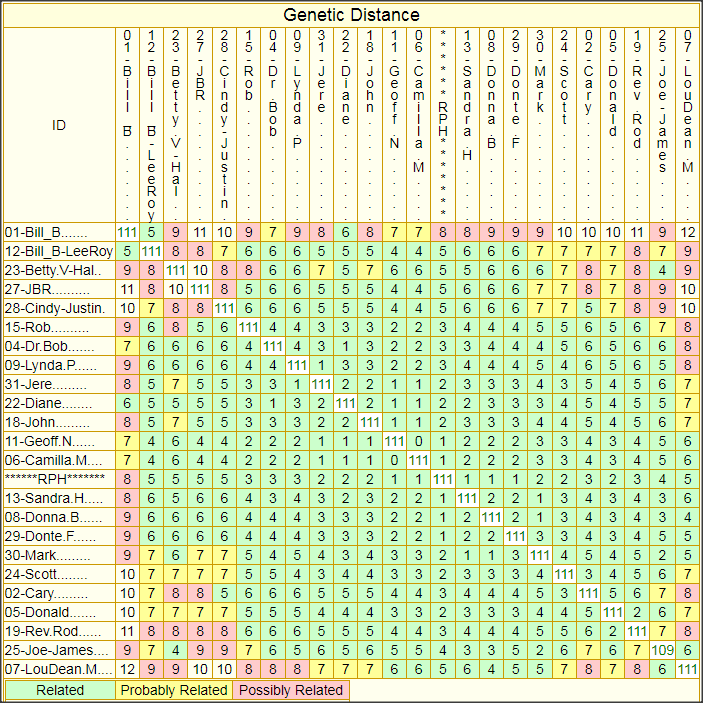
Color-coding shows whether a haplotype pair Definitely, Probably, or just Possibly belongs to the patrilineage.
The number in each cell is the number of divergent mutations between each pair of haplotypes.
The lowest numbers represent the closest relationships.
Whether an outlier haplotype belongs to the same patrilineage should be judged by its lowest GD number.
However, the color-coded categories and the GD numbers don’t take account either of the common surname that most of these haplotypes share,
or of the possible convergence of their genealogical evidence at a particular time and place, and where either of these conditions obtain,
2 or 3 can reasonably be subtracted from the indicated GD in assessing whether an outlying haplotype belongs to the patrilineage.
The ALLEN Patrilineage 1 Mutation History Tree
*** THE MUTATION HISTORY TREE HAS NOT BEEN REVISED TO TAKE ACCOUNT OF THE MANY EXTENSIONS TO 111 MARKERS,
*** OF THE SEVERAL NEW MEMBERS OF THE PROJECT, OR OF THE MAJOR HYPOTHETICAL GENEALOGICAL RECONSTRUCTION OF
*** THE TOP OF THE TREE THAT IS IN PROGRESS. THE LOWER LEVEL GROUPINGS BY MUTATION, THOUGH, ARE STILL VALID.
The following tree chart shows the accumulated mutations for each tested descendant of the MRCA (Most Recent Common Ancestor) of this Allen Patrilineage. The MRCA appears at the top of the tree, and the tested members of the project at the bottom, identified by their Allen Patrilineage Project#, and the “handle” of the principal researcher for each tested member’s line. The other numbers in the chart represent mutations that have occurred, and accumulated, in certain lineages. The three members listed at the bottom of the first column (06-Camilla, 09-Lynda, and 11-Geoff) have a straight, no-mutation descent from the MRCA. Of these three, I have somewhat arbitrarily chosen 06-Camilla as the current RPH of the project—the haplotype that most closely resembles that of the project MRCA, compared with which, the mutations of the others are determined.
The mutations are represented by the numeric IDs of the ySTR markers tested by FTDNA with the “DYS” prefixes truncated to save space. The marker number is followed by a “+” or a “-” to indicate whether the mutation resulted in the gain or loss of a repeat; where there is a two step difference between a member’s marker and that of the RPH, this will be shown as two separate mutations.
The GD (Genetic Distance) between any two members of the patrilineage is equivalent to the number of mutations encountered when tracing a path from their “handle” at the bottom of the tree to that of the other member. For the FTDNA 37-marker panel, one unit of GD between two members suggests that they are related no more closely than second cousins—that their most recent common ancestor was a mutual great-grandfather who lived 3 generations back. In the same way a GD of two between them, would suggest a common ancestor 6 generations back, and so forth. But these are only very rough estimates, and each unit of GD could easily be off by a generation or two either way.
Furthermore, where two members are known not to have a common ancestor a certain number of generations back, this pushes their most recent common ancestor back that many generations plus a couple more. Thus, 06-Camilla (the RPH), who has a GD of 1 from a majority of the other members of the project, and who is known to have no common ancestor with any of them for at least the last three generations has a 25% chance of having a common ancestor with any of her GD 1 cousins 4 generations back, a 60% chance 6 generations back, and an 80% chance 8 generations back (which takes us to about 1700, at 34 years per generation). With Camilla’s perfect 37/37 match to 09-Lynda and 11-Geoff, the odds of a common ancestor with them at 4 generations back go up to 36%, at 6 generations to 74%, and 8 generations to 90%. Since Camilla and Lynda have both tested out to 67 markers, with a perfect 67/67 match, the odds that they have a common ancestor 4 generations back are 44%, 6 generations back 82%, and 8 generations 94%.
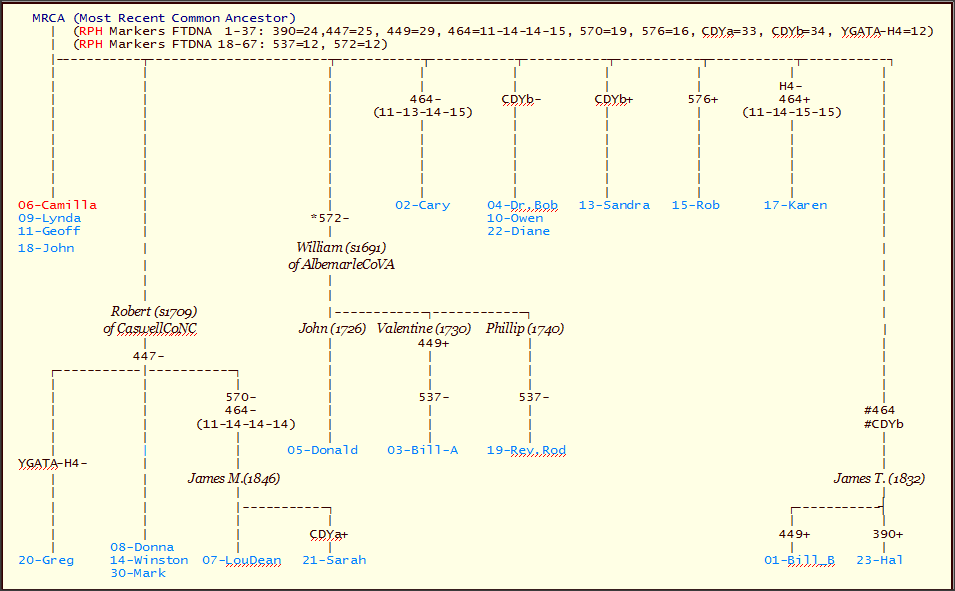
* Mutation 572-, shared by Bill_A and Rev.Rod, may not be shared by Bill_B, who has tested only to 37 markers; thus the latter may not fit into the tree at this point.
ALLEN Patrilineage 1 yDNA (ySTR) Haplotypes
The chart below shows the haplotypes for each tested project member of this patrilineage. I’ve decapitated most of the marker names (truncating “DYS393” to just “393”) to improve readability. The markers with colored headings mutate slower or faster than the norm. Thus, [DYS]439 is a fast mutator, [DYS]458 is faster, and CDYa&s are blazing, while [DYS]393 is slow. The remaining markers fall into the midrange of mutability.
The mutability of the markers that have mutated is important because it’s the shared inherited mutations that identify the Closer Cousin Clusters that it’s the main purpose of testing to ascertain, and when the shared mutations are to faster markers there’s a fair chance that some may have mutated independently in different lines, and thus weren’t inherited from a common ancestor.
| Haplotype Identifiers | FTDNA 37-Marker Panel | FTDNA Markers 38-67 | FTDNA Markers 68-111 | Haplotype Identifiers | |||||||||||||||||||||||||||||||||||||||||||||||||||||||||||||||||||||||||||||||||||||||||||||||||||||||||||||||
|---|---|---|---|---|---|---|---|---|---|---|---|---|---|---|---|---|---|---|---|---|---|---|---|---|---|---|---|---|---|---|---|---|---|---|---|---|---|---|---|---|---|---|---|---|---|---|---|---|---|---|---|---|---|---|---|---|---|---|---|---|---|---|---|---|---|---|---|---|---|---|---|---|---|---|---|---|---|---|---|---|---|---|---|---|---|---|---|---|---|---|---|---|---|---|---|---|---|---|---|---|---|---|---|---|---|---|---|---|---|---|---|---|---|---|---|
Proj # |
Principal Genealogist |
Earliest Known Ancestor Name (Birth - Death) c=circa s=say |
3 9 3 | 3 9 0 |
1 9 / 3 9 4 | 3 9 1 |
3 8 5 a | 3 8 5 b |
4 2 6 |
3 8 8 |
4 3 9 |
3 8 9 I |
3 9 2 |
3 8 9 I I |
4 5 8 |
4 5 9 a |
4 5 9 b |
4 5 5 |
4 5 4 |
4 4 7 |
4 3 7 |
4 4 8 |
4 4 9 |
4 6 4 a |
4 6 4 b |
4 6 4 c |
4 6 4 d |
4 6 0 |
Y G - H 4 |
Y C A I I a |
Y C A I I b |
4 5 6 |
6 0 7 |
5 7 6 |
5 7 0 |
C D Y a |
C D Y b |
4 4 2 |
4 3 8 |
5 3 1 |
5 7 8 |
3 9 5 S 1 a |
3 9 5 S 1 b |
5 9 0 |
5 3 7 |
6 4 1 |
4 7 2 |
4 0 6 S 1 |
5 1 1 |
4 2 5 |
4 1 3 a |
4 1 3 b |
5 5 7 |
5 9 4 |
4 3 6 |
4 9 0 |
5 3 4 |
4 5 0 |
4 4 4 |
4 8 1 |
5 2 0 |
4 4 6 |
6 1 7 |
5 6 8 |
4 8 7 |
5 7 2 |
6 4 0 |
4 9 2 |
5 6 5 |
7 1 0 |
4 8 5 |
6 3 2 |
4 9 5 |
5 4 0 |
7 1 4 |
7 1 6 |
7 1 7 |
5 0 5 |
5 5 6 |
5 4 9 |
5 8 9 |
5 2 2 |
4 9 4 |
5 3 3 |
6 3 6 |
5 7 5 |
6 3 8 |
4 6 2 |
4 5 2 |
4 4 5 |
Y G - A 1 0 |
4 6 3 |
4 4 1 |
Y G - 1 B 0 7 |
5 2 5 |
7 1 2 |
5 9 3 |
6 5 0 |
5 3 2 |
7 1 5 |
5 0 4 |
5 1 3 |
5 6 1 |
5 5 2 |
7 2 6 |
6 3 5 |
5 8 7 |
6 4 3 |
4 9 7 |
5 1 0 |
4 3 4 |
4 6 1 |
4 3 5 |
Proj # |
Principal Genealogist |
| A-01 | Bill B. Allen | JamesT,1832,WiseCoTX | 13 | 24 | 15 | 10 | 12 | 12 | 11 | 15 | 11 | 13 | 11 | 28 | 16 | 8 | 8 | 11 | 11 | 25 | 15 | 20 | 30 | 11g | 14g | 10 | 12 | 11 | 21 | 14 | 12 | 16 | 19 | 33 | 33 | 12 | 10 | 11 | 8 | 16 | 16 | 8 | 12 | 10 | 8 | 11 | 7 | 12 | 20 | 21 | 16 | 11 | 12 | 12 | 14 | 8 | 11 | 21 | 20 | 13 | 13 | 10 | 13 | 12 | 10 | 12 | 11 | 30 | 14 | 8 | 16 | 11 | 26 | 27 | 18 | 11 | 11 | 10 | 11 | 11 | 9 | 12 | 11 | 10 | 12 | 13 | 30 | 11 | 12 | 22 | 15 | 10 | 13 | 21 | 15 | 21 | 11 | 25 | 16 | 12 | 14 | 26 | 12 | 22 | 18 | 12 | 15 | 15 | 9 | 11 | 11 | A-01 | Bill B. Allen | ||
| A-12 | Bill B.(LeeRoy) Allen | JamesT,1832,WiseCoTX | 13 | 24 | 16 | 10 | 12 | 12 | 11 | 15 | 11 | 13 | 11 | 28 | 16 | 8 | 8 | 11 | 11 | 25 | 15 | 20 | 29 | 11 | 11 | 14 | 14+ | 10 | 12 | 11 | 21 | 14 | 12 | 16 | 19 | 33 | 34 | 12 | 10 | 11 | 8 | 16 | 16 | 8 | 12 | 10 | 8 | 11 | 7 | 12 | 20 | 21 | 16 | 11 | 12 | 12 | 14 | 8 | 11 | 21 | 20 | 13 | 13 | 10 | 13 | 12 | 10 | 12 | 11 | 30 | 14 | 8 | 16 | 11 | 26 | 27 | 18 | 11 | 11 | 10 | 11 | 11 | 9 | 12 | 11 | 10 | 12 | 13 | 30 | 11 | 12 | 22 | 15 | 10 | 13 | 21 | 15 | 20 | 11 | 25 | 16 | 12 | 14 | 26 | 12 | 22 | 18 | 12 | 15 | 15 | 9 | 12 | 11 | A-12 | Bill B. (LeeRoy) Allen |
| A-23 | Betty (Bybee) Verplank | Pleasant Bybee,1835,Fluv.CoVA | 13 | 25 | 15 | 10 | 12 | 12 | 11 | 15 | 11 | 13 | 11 | 28 | 16 | 8 | 8 | 11 | 11 | 25 | 15 | 20 | 29 | 11g | 14g | 10 | 12 | 11 | 21 | 14 | 12 | 16 | 19 | 33 | 33 | 12 | 10 | 11 | 8 | 16 | 16 | 8 | 12 | 10 | 8 | 11 | 7 | 12 | 21 | 21 | 16 | 11 | 12 | 12 | 14 | 8 | 11 | 21 | 20 | 13 | 13 | 10 | 13 | 12 | 10 | 12 | 11 | 30 | 14 | 8 | 16 | 11 | 26 | 27 | 18 | 11 | 11 | 10 | 11 | 11 | 9 | 12 | 11 | 10 | 12 | 13 | 30 | 11 | 12 | 22 | 15 | 10 | 13 | 21 | 15 | 20 | 12 | 25 | 17 | 12 | 14 | 26 | 12 | 22 | 18 | 12 | 15 | 15 | 9 | 12 | 11 | A-23 | Betty (Bybee) | ||
| A-27 | JBR (anonymous) | Jacob Allen (s1708 - 1762 PittCoNC) | 13 | 24 | 15 | 10 | 12 | 12 | 11 | 15 | 12 | 13 | 11 | 28 | 16 | 8 | 8 | 11 | 11 | 25 | 15 | 20 | 29 | 11 | 14 | 14 | 15 | 10 | 12 | 11 | 21 | 14 | 12 | 16 | 19 | 33 | 34 | 12 | 10 | 11 | 8 | 16 | 16 | 8 | 12 | 10 | 8 | 11 | 07 | 12 | 21 | 21 | 16 | 11 | 12 | 12 | 14 | 8 | 11 | 21 | 20 | 13 | 13 | 10 | 13 | 12 | 10 | 12 | 11 | 31 | 14 | 8 | 16 | 11 | 26 | 27 | 18 | 11 | 11 | 10 | 11 | 11 | 9 | 12 | 11 | 10 | 12 | 13 | 30 | 11 | 12 | 22 | 15 | 10 | 13 | 21 | 15 | 20 | 11 | 25 | 16 | 12 | 14 | 27 | 12 | 22 | 18 | 12 | 15 | 15 | 9 | 12 | 11 | A-27 | JBR (anonymous) |
| A-17 | Cindy (George) Holder | Johnson Holder (c1830 TN -) | 13 | 24 | 15 | 10 | 12 | 12 | 11 | 15 | 11 | 13 | 11 | 28 | 16 | 8 | 8 | 11 | 11 | 25 | 15 | 20 | 29 | 11 | 14 | 15 | 15 | 10 | 11 | 11 | 21 | 14 | 12 | 16 | 19 | 33 | 34 | 12 | 10 | 11 | 8 | 16 | 16 | 8 | 12 | 10 | 8 | 11 | 7 | 12 | 21 | 21 | 16 | 11 | 12 | 12 | 14 | 8 | 11 | 21 | 20 | 13 | 13 | 10 | 13 | 12 | 10 | 12 | 11 | A-17 | Cindy (George) Holder | ||||||||||||||||||||||||||||||||||||||||||||
| A-28 | Cindy (Justin) Holder | Johnson Holder (c1830 TN -) | 13 | 24 | 15 | 10 | 12 | 12 | 11 | 15 | 11 | 13 | 11 | 28 | 16 | 8 | 8 | 11 | 11 | 25 | 15 | 20 | 29 | 11 | 14 | 15 | 15 | 10 | 12 | 11 | 21 | 14 | 12 | 16 | 19 | 33 | 34 | 11 | 10 | 11 | 8 | 16 | 16 | 8 | 12 | 10 | 8 | 11 | 07 | 12 | 21 | 21 | 16 | 11 | 12 | 12 | 14 | 8 | 11 | 21 | 20 | 13 | 13 | 10 | 13 | 12 | 10 | 12 | 11 | 30 | 14 | 8 | 16 | 11 | 26 | 27 | 18 | 11 | 11 | 10 | 11 | 11 | 9 | 12 | 11 | 10 | 12 | 12 | 30 | 11 | 12 | 22 | 15 | 10 | 13 | 21 | 15 | 20 | 12 | 25 | 16 | 12 | 14 | 26 | 12 | 22 | 18 | 12 | 15 | 15 | 9 | 12 | 11 | A-17 | Cindy (Justin) Holder |
| A-15 | Rob Allen | Reynold,s1723,IredellNC | 13 | 24 | 15 | 10 | 12 | 12 | 11 | 15 | 11 | 13 | 11 | 28 | 16 | 8 | 8 | 11 | 11 | 25 | 15 | 20 | 29 | 11 | 14 | 14 | 15 | 10 | 12 | 11 | 21 | 14 | 12 | 17 | 19 | 33 | 34 | 12 | 10 | 11 | 8 | 16 | 16 | 8 | 12 | 10 | 8 | 11 | 7 | 12 | 21 | 21 | 16 | 11 | 12 | 12 | 14 | 8 | 11 | 21 | 20 | 13 | 13 | 10 | 13 | 12 | 10 | 12 | 11 | 29 | 14 | 8 | 16 | 11 | 26 | 27 | 18 | 11 | 11 | 10 | 11 | 11 | 9 | 12 | 11 | 10 | 12 | 13 | 30 | 11 | 12 | 22 | 15 | 10 | 13 | 21 | 15 | 20 | 11 | 25 | 16 | 12 | 14 | 26 | 12 | 22 | 18 | 12 | 15 | 15 | 9 | 12 | 11 | A-15 | Rob Allen |
| A-31 | Jere Allen | Reynold,s1723,IredellNC | 13 | 24 | 15 | 10 | 12 | 12 | 11 | 15 | 11 | 13 | 11 | 28 | 16 | 8 | 8 | 11 | 11 | 25 | 15 | 20 | 29 | 11 | 14 | 14 | 15 | 10 | 12 | 11 | 21 | 14 | 12 | 16 | 19 | 33 | 34 | 12 | 10 | 11 | 8 | 16 | 16 | 8 | 12 | 10 | 8 | 11 | 7 | 12 | 21 | 21 | 16 | 11 | 12 | 12 | 14 | 8 | 11 | 21 | 20 | 13 | 13 | 10 | 13 | 12 | 10 | 12 | 11 | 30 | 14 | 8 | 16 | 11 | 26 | 27 | 18 | 11 | 11 | 10 | 11 | 11 | 9 | 12 | 11 | 10 | 12 | 13 | 30 | 11 | 12 | 22 | 15 | 10 | 13 | 20 | 15 | 20 | 11 | 25 | 16 | 12 | 14 | 26 | 12 | 22 | 18 | 12 | 15 | 15 | 9 | 12 | 11 | A-31 | Jere Allen |
| A-18 | John Allen | Wm,c1726,MecklenburgCoVA | 13 | 24 | 15 | 10 | 12 | 12 | 11 | 15 | 11 | 13 | 11 | 29 | 16 | 8 | 8 | 11 | 11 | 25 | 15 | 20 | 29 | 11 | 14 | 14 | 15 | 10 | 12 | 11 | 21 | 14 | 12 | 16 | 19 | 33 | 34 | 12 | 10 | 11 | 8 | 16 | 16 | 8 | 12 | 10 | 8 | 11 | 7 | 12 | 21 | 21 | 16 | 11 | 12 | 12 | 14 | 8 | 11 | 21 | 20 | 13 | 13 | 10 | 13 | 12 | 10 | 12 | 11 | 30 | 14 | 8 | 16 | 11 | 26 | 27 | 18 | 11 | 11 | 10 | 11 | 11 | 9 | 12 | 11 | 10 | 12 | 13 | 30 | 11 | 12 | 22 | 15 | 10 | 13 | 21 | 15 | 20 | 11 | 25 | 16 | 12 | 14 | 26 | 12 | 22 | 18 | 12 | 15 | 15 | 9 | 12 | 11 | A-18 | John Allen |
| A-11 | Geoff Nesbitt | Robert Nesbitt,1831,TX | 13 | 24 | 15 | 10 | 12 | 12 | 11 | 15 | 11 | 13 | 11 | 28 | 16 | 8 | 8 | 11 | 11 | 25 | 15 | 20 | 29 | 11 | 14 | 14 | 15 | 10 | 12 | 11 | 21 | 14 | 12 | 16 | 19 | 33 | 34 | 12 | 10 | 11 | 8 | 16 | 16 | 8 | 12 | 10 | 8 | 11 | 7 | 12 | 21 | 21 | 16 | 11 | 12 | 12 | 14 | 8 | 11 | 21 | 20 | 13 | 13 | 10 | 13 | 12 | 10 | 12 | 11 | 30 | 14 | 8 | 16 | 11 | 26 | 27 | 18 | 11 | 11 | 10 | 11 | 11 | 9 | 12 | 11 | 10 | 12 | 13 | 30 | 11 | 12 | 22 | 15 | 10 | 13 | 21 | 15 | 20 | 11 | 25 | 16 | 12 | 14 | 26 | 12 | 22 | 18 | 12 | 15 | 15 | 9 | 12 | 11 | A-11 | Geoff Nesbitt |
| A-22 | Diane Allen | Wm,c1726,MecklenburgCoVA | 13 | 24 | 15 | 10 | 12 | 12 | 11 | 15 | 11 | 13 | 11 | 28 | 16 | 8 | 8 | 11 | 11 | 25 | 15 | 20 | 29 | 11 | 14 | 14 | 15 | 10 | 12 | 11 | 21 | 14 | 12 | 16 | 19 | 33 | 33 | 12 | 10 | 11 | 8 | 16 | 16 | 8 | 12 | 10 | 8 | 11 | 7 | 12 | 21 | 21 | 16 | 11 | 12 | 12 | 14 | 8 | 11 | 21 | 20 | 13 | 13 | 10 | 13 | 12 | 10 | 12 | 11 | 30 | 14 | 8 | 16 | 11 | 26 | 27 | 18 | 11 | 11 | 10 | 11 | 11 | 9 | 12 | 11 | 10 | 12 | 13 | 30 | 11 | 12 | 22 | 15 | 10 | 13 | 21 | 15 | 20 | 11 | 25 | 16 | 12 | 14 | 26 | 12 | 22 | 18 | 12 | 15 | 15 | 9 | 12 | 11 | A-22 | Diane Allen |
| A-10 | Owen Allen | Russell,1828,AL | 13 | 24 | 15 | 10 | 12 | 12 | 11 | 15 | 11 | 13 | 11 | 28 | 16 | 8 | 8 | 11 | 11 | 25 | 15 | 20 | 29 | 11 | 14 | 14 | 15 | 10 | 12 | 11 | 21 | 14 | 12 | 16 | 19 | 33 | 33 | 12 | 10 | 11 | 8 | 16 | 16 | 8 | 12 | 10 | 8 | 11 | 7 | 12 | 21 | 21 | 16 | 11 | 12 | 12 | 14 | 8 | 11 | 21 | 20 | 13 | 13 | 10 | 13 | 12 | 10 | 12 | 11 | A-10 | Owen Allen | ||||||||||||||||||||||||||||||||||||||||||||
| A-04 | Dr. Bob Allen | Wm,c1726,MecklenburgCoVA | 13 | 24 | 15 | 10 | 12 | 12 | 11 | 15 | 11 | 13 | 11 | 28 | 16 | 8 | 8 | 11 | 11 | 25 | 15 | 20 | 29 | 11 | 14 | 14 | 15 | 10 | 12 | 11 | 21 | 14 | 12 | 16 | 19 | 33 | 33 | 12 | 10 | 11 | 8 | 16 | 16 | 8 | 12 | 10 | 8 | 11 | 7 | 12 | 21 | 21 | 16 | 11 | 12 | 12 | 14 | 8 | 11 | 21 | 20 | 13 | 13 | 10 | 13 | 12 | 10 | 12 | 11 | 30 | 14 | 8 | 16 | 11 | 26 | 27 | 18 | 11 | 11 | 10 | 11 | 11 | 9 | 12 | 11 | 10 | 12 | 13 | 30 | 11 | 12 | 22 | 15 | 10 | 13 | 21 | 15 | 20 | 11 | 25 | 16 | 12 | 14 | 26 | 12 | 22 | 18 | 12 | 14 | 15 | 9 | 12 | 11 | A-04 | Dr.Bob |
| A-09 | Lynda Page | Wm,c1726,MecklenburgCoVA | 13 | 24 | 15 | 10 | 12 | 12 | 11 | 15 | 11 | 13 | 11 | 28 | 16 | 8 | 8 | 11 | 11 | 25 | 15 | 20 | 29 | 11 | 14 | 14 | 15 | 10 | 12 | 11 | 21 | 14 | 12 | 16 | 19 | 33 | 34 | 12 | 10 | 11 | 8 | 16 | 16 | 8 | 12 | 10 | 8 | 11 | 7 | 12 | 21 | 21 | 16 | 11 | 12 | 12 | 14 | 8 | 11 | 21 | 20 | 13 | 13 | 10 | 13 | 12 | 10 | 12 | 11 | 30 | 14 | 8 | 16 | 11 | 26 | 27 | 18 | 11 | 11 | 10 | 11 | 11 | 9 | 12 | 11 | 10 | 12 | 13 | 30 | 11 | 12 | 22 | 15 | 10 | 12 | 20 | 15 | 20 | 11 | 25 | 16 | 12 | 14 | 26 | 12 | 22 | 18 | 12 | 15 | 15 | 9 | 12 | 11 | A-09 | Lynda Page |
| A-06 | Camilla Mitchell | James,1814,GonzalesCoTX | 13 | 24 | 15 | 10 | 12 | 12 | 11 | 15 | 11 | 13 | 11 | 28 | 16 | 8 | 8 | 11 | 11 | 25 | 15 | 20 | 29 | 11 | 14 | 14 | 15 | 10 | 12 | 11 | 21 | 14 | 12 | 16 | 19 | 33 | 34 | 12 | 10 | 11 | 8 | 16 | 16 | 8 | 12 | 10 | 8 | 11 | 7 | 12 | 21 | 21 | 16 | 11 | 12 | 12 | 14 | 8 | 11 | 21 | 20 | 13 | 13 | 10 | 13 | 12 | 10 | 12 | 11 | 30 | 14 | 8 | 16 | 11 | 26 | 27 | 18 | 11 | 11 | 10 | 11 | 11 | 9 | 12 | 11 | 10 | 12 | 13 | 30 | 11 | 12 | 22 | 15 | 10 | 13 | 21 | 15 | 20 | 11 | 25 | 16 | 12 | 14 | 26 | 12 | 22 | 18 | 12 | 15 | 15 | 9 | 12 | 11 | A-06 | Camilla Mitchell |
| Root Prototype Haplotype | 13 | 24 | 15 | 10 | 12 | 12 | 11 | 15 | 11 | 13 | 11 | 28 | 16 | 8 | 8 | 11 | 11 | 25 | 15 | 20 | 29 | 11 | 14 | 14 | 15 | 10 | 12 | 11 | 21 | 14 | 12 | 16 | 19 | 33 | 34 | 12 | 10 | 11 | 8 | 16 | 16 | 8 | 12 | 10 | 8 | 11 | 7 | 12 | 21 | 21 | 16 | 11 | 12 | 12 | 14 | 8 | 11 | 21 | 20 | 13 | 13 | 10 | 13 | 12 | 10 | 12 | 11 | 30 | 14 | 8 | 16 | 11 | 26 | 27 | 18 | 11 | 11 | 10 | 11 | 11 | 9 | 12 | 11 | 10 | 12 | 13 | 30 | 11 | 12 | 22 | 15 | 10 | 13 | 21 | 15 | 20 | 11 | 25 | 17 | 12 | 14 | 26 | 12 | 22 | 18 | 12 | 15 | 15 | 9 | 12 | 11 | RPH | |||
| A-19 | Rev.Rod Allen | William,s1687,AlbemarleVA | 13 | 24 | 15 | 10 | 12 | 12 | 11 | 15 | 11 | 13 | 11 | 28 | 16 | 8 | 8 | 11 | 11 | 25 | 15 | 20 | 29 | 11 | 14 | 14 | 15 | 10 | 12 | 11 | 21 | 14 | 12 | 16 | 19 | 33 | 34 | 12 | 10 | 11 | 8 | 16 | 16 | 8 | 11 | 10 | 8 | 11 | 7 | 12 | 21 | 21 | 16 | 11 | 12 | 12 | 14 | 8 | 11 | 21 | 20 | 13 | 13 | 10 | 13 | 11 | 10 | 12 | 11 | 30 | 14 | 8 | 16 | 11 | 25 | 27 | 18 | 11 | 11 | 10 | 11 | 11 | 9 | 12 | 11 | 10 | 12 | 13 | 30 | 11 | 12 | 22 | 15 | 10 | 13 | 21 | 15 | 20 | 11 | 25 | 17 | 12 | 14 | 26 | 12 | 22 | 18 | 12 | 15 | 15 | 9 | 12 | 11 | A-19 | Rev.Rod Allen |
| A-05 | Donald Allen | William,s1687,AlbemarleVA | 13 | 24 | 15 | 10 | 12 | 12 | 11 | 15 | 11 | 13 | 11 | 28 | 16 | 8 | 8 | 11 | 11 | 25 | 15 | 20 | 29 | 11 | 14 | 14 | 15 | 10 | 12 | 11 | 21 | 14 | 12 | 16 | 19 | 33 | 34 | 12 | 10 | 11 | 8 | 16 | 16 | 8 | 12 | 10 | 8 | 11 | 7 | 12 | 21 | 21 | 16 | 11 | 12 | 12 | 14 | 8 | 11 | 21 | 20 | 13 | 13 | 10 | 13 | 11 | 10 | 12 | 11 | 30 | 14 | 8 | 16 | 11 | 27 | 27 | 18 | 11 | 11 | 10 | 11 | 11 | 9 | 12 | 11 | 10 | 12 | 13 | 30 | 11 | 12 | 22 | 15 | 10 | 13 | 21 | 15 | 20 | 11 | 25 | 17 | 12 | 14 | 26 | 12 | 22 | 18 | 12 | 15 | 15 | 9 | 12 | 11 | A-05 | Donald Allen |
| A-03 | Bill A. Allen | William,s1687,AlbemarleVA | 13 | 24 | 15 | 10 | 12 | 12 | 11 | 15 | 11 | 13 | 11 | 28 | 16 | 8 | 8 | 11 | 11 | 25 | 15 | 20 | 30 | 11 | 14 | 14 | 15 | 10 | 12 | 11 | 21 | 14 | 12 | 16 | 19 | 33 | 34 | 12 | 10 | 11 | 8 | 16 | 16 | 8 | 12 | 10 | 8 | 11 | 7 | 12 | 21 | 21 | 16 | 11 | 12 | 12 | 14 | 8 | 11 | 21 | 20 | 13 | 13 | 10 | 13 | 11 | 10 | 12 | 11 | A-03 | Bill A. Allen | ||||||||||||||||||||||||||||||||||||||||||||
| A-13 | Sandra Hunt | Frank Harris,1850,AL | 13 | 24 | 15 | 10 | 12 | 12 | 11 | 15 | 11 | 13 | 11 | 28 | 16 | 8 | 8 | 11 | 11 | 25 | 15 | 20 | 29 | 11 | 14 | 14 | 15 | 10 | 12 | 11 | 21 | 14 | 12 | 16 | 19 | 33 | 35 | 12 | 10 | 11 | 8 | 16 | 16 | 8 | 12 | 10 | 8 | 11 | 7 | 12 | 21 | 21 | 16 | 11 | 12 | 12 | 14 | 8 | 11 | 21 | 20 | 13 | 13 | 10 | 13 | 12 | 10 | 12 | 11 | 30 | 14 | 8 | 16 | 11 | 26 | 27 | 18 | 11 | 11 | 10 | 11 | 11 | 9 | 12 | 11 | 10 | 12 | 13 | 30 | 11 | 12 | 22 | 15 | 10 | 13 | 21 | 15 | 20 | 11 | 25 | 17 | 12 | 14 | 26 | 12 | 22 | 18 | 12 | 15 | 15 | 9 | 12 | 11 | A-13 | Sandra Hunt |
| A-29 | Donte Fleming | Charles (c1800 NC - 1870+ ClayCoGA) | 13 | 24 | 15 | 10 | 12 | 12 | 11 | 15 | 11 | 13 | 11 | 28 | 16 | 8 | 8 | 11 | 11 | 25 | 15 | 20 | 29 | 11 | 14 | 14 | 15 | 10 | 12 | 11 | 21 | 14 | 12 | 16 | 20 | 33 | 34 | 12 | 10 | 11 | 8 | 16 | 16 | 8 | 12 | 10 | 8 | 11 | 7 | 12 | 21 | 21 | 16 | 11 | 12 | 12 | 14 | 8 | 11 | 21 | 20 | 13 | 13 | 10 | 13 | 12 | 10 | 12 | 11 | 30 | 14 | 8 | 16 | 11 | 26 | 27 | 18 | 11 | 11 | 10 | 11 | 11 | 9 | 12 | 11 | 10 | 12 | 13 | 30 | 11 | 12 | 22 | 15 | 10 | 13 | 21 | 15 | 20 | 11 | 25 | 17 | 12 | 14 | 26 | 12 | 22 | 18 | 12 | 15 | 15 | 9 | 12 | 11 | A-29 | Donte Fleming |
| A-24 | Scott Allen | Gideon, abt 1794, TX? | 13 | 24 | 15 | 10 | 12 | 12 | 11 | 15 | 11 | 13 | 11 | 28 | 16 | 8 | 8 | 11 | 11 | 25 | 15 | 20 | 29 | 11 | 14 | 14 | 15 | 10 | 12 | 11 | 21 | 14 | 12 | 16 | 19 | 33 | 34 | 12 | 10 | 11 | 8 | 16 | 16 | 8 | 12 | 10 | 8 | 10 | 7 | 12 | 21 | 21 | 16 | 11 | 12 | 12 | 14 | 8 | 11 | 21 | 20 | 13 | 13 | 10 | 13 | 12 | 10 | 12 | 11 | 30 | 14 | 8 | 16 | 11 | 26 | 27 | 18 | 11 | 11 | 10 | 11 | 11 | 9 | 12 | 11 | 10 | 12 | 13 | 30 | 11 | 12 | 22 | 15 | 10 | 13 | 22 | 15 | 20 | 11 | 25 | 17 | 12 | 14 | 26 | 12 | 22 | 18 | 12 | 15 | 15 | 9 | 12 | 11 | A-24 | Scott Allen |
| A-02 | Cary Allen | William, say 1781, NC? | 13 | 24 | 15 | 10 | 12 | 12 | 11 | 15 | 11 | 13 | 11 | 28 | 16 | 8 | 8 | 11 | 11 | 25 | 15 | 20 | 29 | 11g | 13g | 14g | 15g | 10 | 12 | 11 | 21 | 14 | 12 | 16 | 19 | 33 | 34 | 12 | 10 | 11 | 8 | 16 | 16 | 8 | 12 | 10 | 8 | 10 | 07 | 12 | 21 | 21 | 16 | 11 | 12 | 12 | 14 | 8 | 11 | 21 | 20 | 13 | 13 | 10 | 13 | 12 | 10 | 12 | 11 | 30 | 14 | 8 | 16 | 11 | 26 | 27 | 18 | 11 | 11 | 10 | 11 | 11 | 9 | 12 | 11 | 10 | 12 | 12 | 30 | 11 | 12 | 22 | 15 | 10 | 13 | 21 | 15 | 20 | 11 | 25 | 17 | 12 | 14 | 26 | 12 | 22 | 18 | 12 | 15 | 15 | 9 | 12 | 11 | A-02 | Cary Allen |
| A-08 | Donna Bailey | Robert,s1680,HenricoCoVA | 13 | 24 | 15 | 10 | 12 | 12 | 11 | 15 | 11 | 13 | 11 | 28 | 16 | 8 | 8 | 11 | 11 | 24 | 15 | 20 | 29 | 11 | 14 | 14 | 15 | 10 | 12 | 11 | 21 | 14 | 12 | 16 | 19 | 33 | 34 | 12 | 10 | 11 | 8 | 16 | 16 | 8 | 12 | 10 | 8 | 11 | 7 | 12 | 21 | 21 | 16 | 11 | 12 | 12 | 14 | 8 | 11 | 21 | 20 | 13 | 13 | 10 | 13 | 12 | 10 | 12 | 11 | 30 | 14 | 8 | 16 | 11 | 26 | 27 | 18 | 11 | 11 | 10 | 11 | 11 | 9 | 12 | 11 | 10 | 12 | 13 | 30 | 11 | 12 | 22 | 15 | 10 | 13 | 21 | 15 | 20 | 11 | 25 | 17 | 12 | 14 | 26 | 12 | 22 | 18 | 12 | 15 | 15 | 9 | 12 | 11 | A-08 | Donna Bailey |
| A-30 | Mark Allen | Robert,s1680,HenricoCoVA | 13 | 24 | 15 | 10 | 12 | 12 | 11 | 15 | 11 | 13 | 11 | 28 | 16 | 08 | 08 | 11 | 11 | 24 | 15 | 20 | 29 | 11 | 14 | 14 | 15 | 10 | 12 | 11 | 21 | 14 | 12 | 16 | 19 | 33 | 35 | 12 | 10 | 11 | 08 | 16 | 16 | 08 | 12 | 10 | 08 | 11 | 07 | 12 | 21 | 21 | 16 | 11 | 12 | 12 | 14 | 08 | 11 | 21 | 20 | 13 | 13 | 10 | 13 | 12 | 10 | 12 | 11 | 30 | 14 | 08 | 16 | 11 | 26 | 27 | 18 | 11 | 11 | 10 | 11 | 11 | 09 | 12 | 11 | 10 | 12 | 13 | 30 | 11 | 12 | 22 | 15 | 10 | 13 | 21 | 15 | 20 | 11 | 25 | 17 | 12 | 14 | 26 | 12 | 22 | 18 | 12 | 15 | 15 | 09 | 12 | 11 | A-30 | Mark Allen |
| A-14 | Winston Allen | CharlesHenryFM,c1825,AL | 13 | 24 | 15 | 10 | 12 | 12 | 11 | 15 | 11 | 13 | 11 | 28 | 16 | 8 | 8 | 11 | 11 | 24 | 15 | 20 | 29 | 11 | 14 | 14 | 15 | 10 | 12 | 11 | 21 | 14 | 12 | 16 | 19 | 33 | 34 | 12 | 10 | A-14 | Winston Allen | ||||||||||||||||||||||||||||||||||||||||||||||||||||||||||||||||||||||||||
| A-25 | Joe (JamesM) Allen | David,c1796,ClevelandCoNC | 13 | 24 | 15 | 10 | 12 | 12 | 11 | 15 | 11 | 13 | 11 | 28 | 16 | 8 | 8 | 11 | 11 | 24 | 15 | 00 | 29 | 11 | 11 | 14 | 14 | 10 | 12 | 11 | 21 | 14 | 12 | 16 | 19 | 33 | 35 | 12 | 10 | 11 | 8 | 16 | 16 | 8 | 12 | 10 | 8 | 11 | 7 | 12 | 21 | 21 | 16 | 11 | 12 | 12 | 14 | 8 | 11 | 21 | 20 | 13 | 13 | 10 | 13 | 12 | 10 | 12 | 11 | 30 | 14 | 8 | 16 | 11 | 26 | 27 | 18 | 11 | 11 | 10 | 00 | 11 | 9 | 12 | 11 | 10 | 12 | 13 | 30 | 11 | 12 | 22 | 15 | 10 | 12 | 21 | 15 | 20 | 11 | 25 | 17 | 12 | 14 | 26 | 12 | 22 | 18 | 12 | 15 | 15 | 9 | 12 | 11 | A-25 | Joe (JamesM) Allen |
| A-26 | Joe (JohnD) Allen | David,c1796,ClevelandCoNC | 13 | 24 | 15 | 10 | 12 | 12 | 11 | 15 | 11 | 13 | 11 | 28 | 16 | 8 | 8 | 11 | 11 | 24 | 15 | 00 | 29 | 11 | 11 | 14 | 14 | 10 | 11 | 11 | 21 | 14 | 12 | 16 | 19 | 33 | 34 | 12 | 10 | A-26 | Joe (JohnD) Allen | ||||||||||||||||||||||||||||||||||||||||||||||||||||||||||||||||||||||||||
| A-20 | Greg Allen | [Larkin?], c1765, NC | 13 | 24 | 15 | 10 | 12 | 12 | 11 | 15 | 11 | 13 | 11 | 28 | 16 | 8 | 8 | 11 | 11 | 24 | 15 | 20 | 29 | 11 | 14 | 14 | 15 | 10 | 11 | 11 | 21 | 14 | 12 | 16 | 19 | 33 | 34 | 12 | 10 | A-20 | Greg Allen | ||||||||||||||||||||||||||||||||||||||||||||||||||||||||||||||||||||||||||
| A-07 | LouDean Mayes | Joseph,1760,ElbertCoGA | 13 | 24 | 15 | 10 | 12 | 12 | 11 | 15 | 11 | 13 | 11 | 28 | 16 | 8 | 8 | 11 | 11 | 24 | 15 | 20 | 29 | 11g | 14g | 14g | 14g | 10 | 12 | 11 | 21 | 14 | 12 | 16 | 18 | 33 | 34 | 12 | 10 | 11 | 8 | 16 | 16 | 8 | 12 | 10 | 8 | 11 | 7 | 12 | 21 | 21 | 16 | 11 | 12 | 12 | 14 | 8 | 11 | 21 | 20 | 13 | 13 | 10 | 13 | 12 | 10 | 12 | 11 | 30 | 14 | 8 | 16 | 11 | 26 | 27 | 18 | 11 | 11 | 10 | 11 | 11 | 9 | 12 | 11 | 10 | 12 | 13 | 30 | 11 | 12 | 22 | 15 | 10 | 13 | 21 | 15 | 20 | 11 | 25 | 17 | 12 | 14 | 26 | 12 | 21 | 19 | 12 | 15 | 15 | 9 | 12 | 11 | A-07 | LouDean Mayes |
| A-21 | Sarah Dacus | Joseph,1760,ElbertCoGA | 13 | 24 | 15 | 10 | 12 | 12 | 11 | 15 | 11 | 13 | 11 | 28 | 16 | 8 | 8 | 11 | 11 | 24 | 15 | 20 | 29 | 11 | 14 | 14 | 14 | 10 | 12 | 11 | 21 | 14 | 12 | 16 | 18 | 34 | 34 | 12 | 10 | A-21 | Sarah Dacus | ||||||||||||||||||||||||||||||||||||||||||||||||||||||||||||||||||||||||||
You may click on highlighted Project#s (like A-01) to see the posted pedigree for a particular test subject. Click on the name of the Principal Genealogist, like Bill_B Allen to go to the project directory that shows the full names of the members and provides clickable e-mail links for the names highlighted there. The Earliest Known Patrilineal Ancestor (and/or his data) is as projected by the editor (JBR), and may not fully reflect the opinions of the Principal Genealogist of that line.
The chart scrolls to the right to show tested markers beyond the first 37. A synthetic Root Prototype Haplotype (RPH) has been constructed to represent the most likely (unmutated) haplotype of the Most Recent Common Patriarchal Ancestor (MRCPA) of all the members of this project. In most cases the marker values of this RPH are those which are the most common across all of the haplotypes. Marker values that deviate from those of the RPH are deemed to be mutations, and are highlighted in lime green—or tomato for multistep mutations. Markers with null values (deletions) are rendered in dark seagreen. Where the multicopy markers DYS464 and YCA (each taken as a whole) diverge in value from those of the RPH, the whole adjacent set of values will be colored yellow green, and will be counted as a single mutation. In the same way, reclOH mutations, which may affect several blocks of separated markers, will be colored orange and treated all as a single mutation when calculating Genetic Distance.
For haplotypes A-01, -12, and -23,I originally scored DYS464 and the CDYs as a single reclOH mutation, but the extension of A-01 and -23 to 111 markers has changed my mind about that. Haplotype A-12, meanwhile, was at the same time extended from 12 to 67 markers and his DYS464 was found to have extra values, viz. 11-11-14-14-14-15. A-01 and A-23 have been subjected to the DYS464X test which shows that almost certainly they’ve inherited the same mutation from a mutual MRCPA, and because A-12’s ancestry tracks so closely with A-01’s we may presume that he did too. Haplotypes A-02 and A-07 have also been tested on the definitive DYS464X test, which shows that each of these experienced different mutations to DYS464.
*** THIS CONTENT WAS STOLEN FROM JOHNBROBB.COM IN VIOLATION OF COPYRIGHT LAW ***
Last updated 1Dec2021
© John Barrett Robb


*** THIS PAGE WAS STOLEN FROM JOHNBROBB.COM IN VIOLATION OF COPYRIGHT LAW ***